The chef's knife
The difference is less about Germany and Japan than about how you move the knife. Rock it, and you want a chef's knife. Chop straight down, and a santoku will feel natural.
Tap either one to check today’s price.
The chef's knife
The santoku
Even on the lines that differ: 1 each.
| Feature | Wusthof Classic 8" Chef's Knife | Wusthof Classic 7" Santoku Knife |
|---|---|---|
| Blade length | 8 in | 7 in |
| Blade height at the heelEven | 1.9 in (Wusthof) | 1.8 in (Wusthof) |
| Profile | Curved belly that rocks, pointed tip | Flatter edge, spine curves down to a blunt tip |
| Edge angle | About 14 degrees per side (Wusthof) | 10 degrees per side (Wusthof) (the edge) |
| HardnessEven | 58 HRC | 58 HRC |
| Edge | Plain | Hollow edge: scallops that help food fall away |
| Best at | Rock-chopping herbs, breaking down poultry, carving, large squash | Thin slices of vegetables, fish and boneless meat, push cuts |
| Tip work | Pointed tip for scoring and fine detail (the edge) | Blunt tip; little use for piercing |
| Price on AmazonEven | About $170 | About $170 |
| Made inEven | Solingen, Germany | Solingen, Germany |
The verdict
If you will own one knife, make it the 8 inch chef's knife: it is longer, it has a point, and it rocks through herbs and carves a chicken. Choose the santoku if you chop straight up and down, cut mostly vegetables and boneless meat, or find an 8 inch blade too much on a small board.
The chef's knife worth buying once.The chef's knife for under $100.The knife set for home cooks.
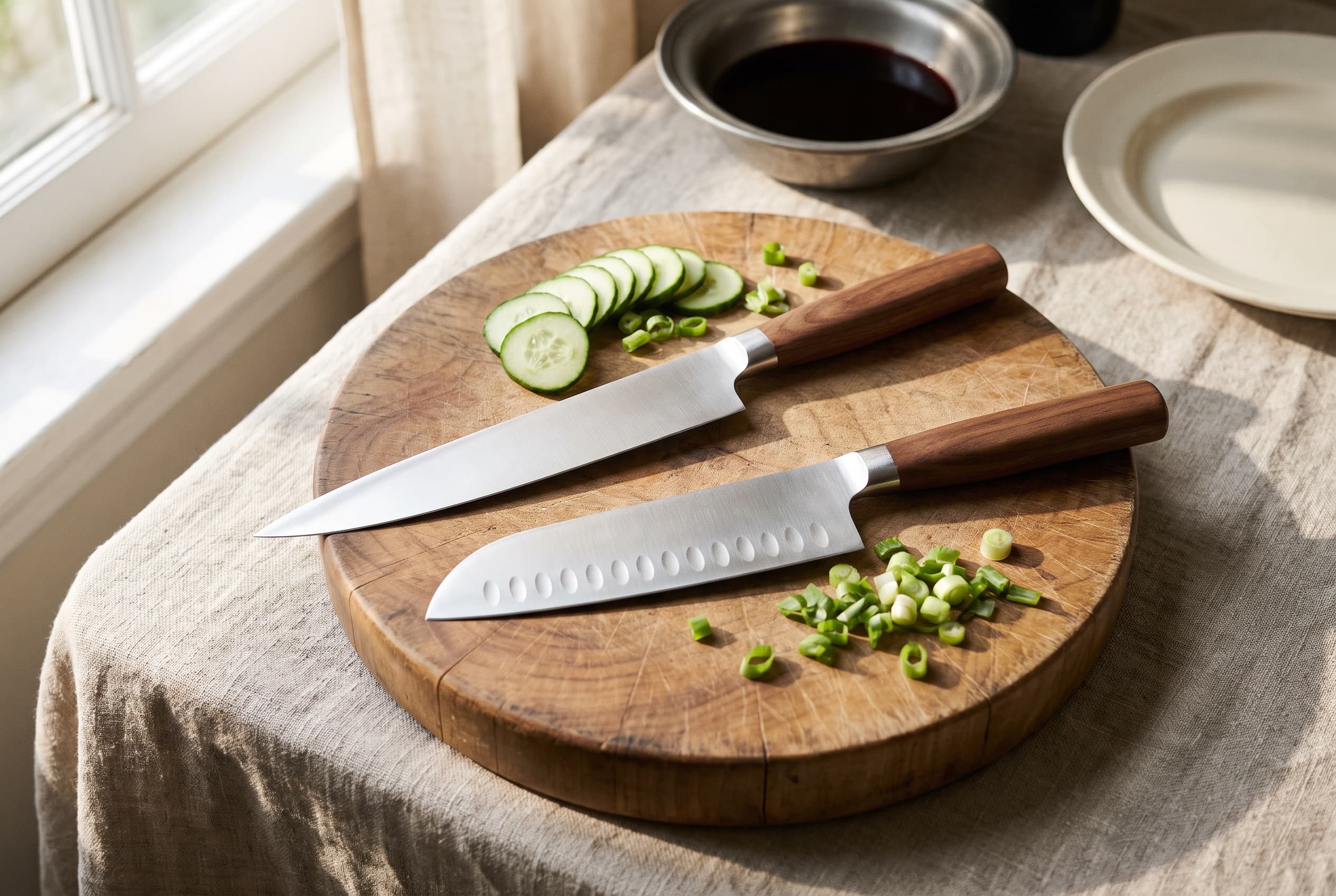
A chef's knife has a long, curved edge that lets the blade rock on the board while the handle rises and falls. A santoku is shorter, with a flatter edge and a spine that curves down to meet it, so the knife works by pushing forward and down rather than rocking. The name is usually translated as three virtues, for slicing, dicing and mincing.
To keep the comparison fair, the two knives here come from the same maker and the same line: Wusthof's Classic 8 inch chef's knife and Classic 7 inch hollow-edge santoku, both forged in Solingen, both hardened to 58 HRC, both about $170. What changes is the shape and the edge. Wusthof sharpens its Asian-style knives, the santoku included, to 10 degrees per side, and its standard Western knives to about 14.
So the santoku is the keener knife out of the box, and the chef's knife is the more versatile one. Most cooks who own both reach for the chef's knife more often. Our guide to the chef's knife worth buying once covers more 8 inch options, and Wusthof vs Shun takes up the German and Japanese question directly.
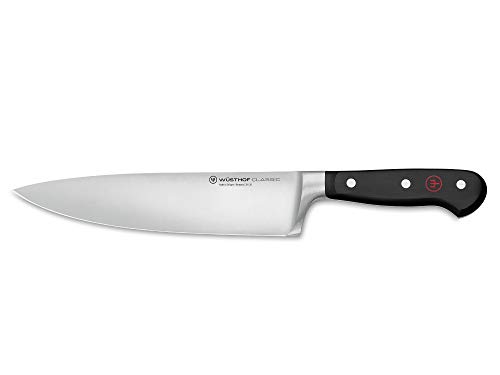
The all-purpose Western knife: long enough for a cabbage, pointed for detail, and sturdy enough for a chicken joint.
The Classic 8 inch is forged from a single piece of high-carbon stainless steel, hardened to 58 HRC, with a full bolster and a triple-riveted synthetic handle. Wusthof lists the blade at 8 inches long and 1.9 inches high at the heel, and the listing gives the weight as 8.5 ounces.
The curved belly is the point of it. You can rock through parsley and garlic without lifting the tip, then turn the knife on its point to score a duck breast or take out a pepper core. The heavier blade goes through a chicken joint or a butternut squash without worry.
Skip it if you have small hands, a small board, or cut straight down by habit. The length and the bolster both take some getting used to, and the bolster has to be ground back over years of sharpening.
The catch. The full bolster complicates sharpening over the long run.
Where to buy
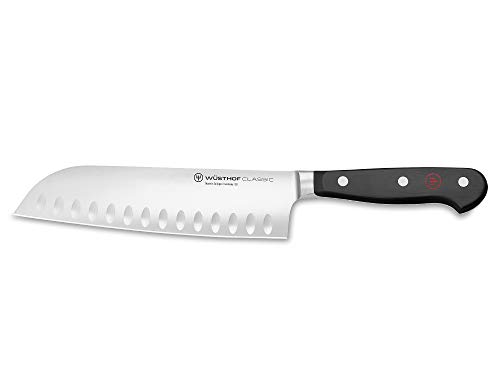
AmazonCheck price →The same steel and handle as the chef's knife, in a shorter, flatter blade with a finer edge.
This is Wusthof's Classic santoku with a hollow edge, model 1040131317: forged from one piece of high-carbon stainless, hardened to 58 HRC, with a full bolster and the same triple-riveted handle as the chef's knife. Wusthof lists a 7 inch blade 1.8 inches high and sharpens its Asian-style knives to 10 degrees per side.
The flatter edge meets the board along more of its length, which suits a straight push or chop through onions, carrots and cucumbers. The scallops ground into the sides leave air pockets so slices of potato or cheese are less likely to cling. The blunt tip makes it a little less useful for fine point work.
Skip it if you rock-chop herbs or break down poultry; the flat edge and short blade are not made for either. One owner on Wusthof's own site notes that years of sharpening wore the edge back past the hollows, which is the long-run cost of the scallops.
The catch. Short and flat, so it is the wrong knife for rocking, carving or bones.
Where to buy
AmazonCheck price →A thin, hard Japanese santoku backed by the maker's free sharpening service.

The Shun Classic santoku has a VG-MAX steel core clad in Damascus layers, a 16 degree edge and a D-shaped Pakkawood handle, and it is made in Japan. Like every Shun, it is covered by Kai's free sharpening program for original owners, who pay a return shipping and processing fee in the US.
Its steel is harder than the Wusthof's, so it holds an edge longer. That hardness makes it more prone to small chips from bones, frozen food and stone or glass boards, so it suits a cook who uses a wooden board and keeps the knife to vegetables, fish and boneless meat.
The catch. Harder steel chips more readily than German steel. Keep it off bones and out of the dishwasher.
Where to buy
AmazonCheck price →A stamped Swiss santoku with a scalloped edge, for trying the shape before spending $150 or more.
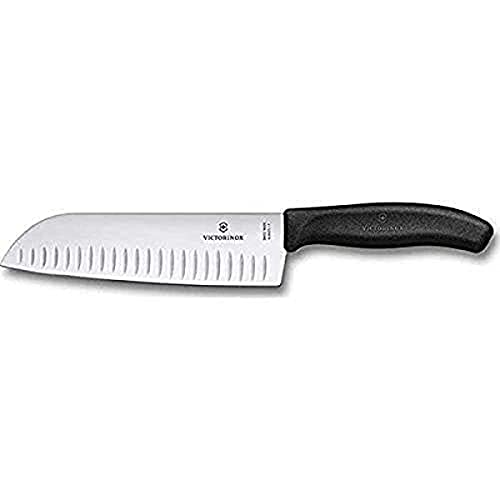
The Fibrox Pro santoku is stamped from sheet steel rather than forged, with a non-slip plastic handle and a Granton edge of scallops on both sides. Victorinox makes it in Switzerland and covers it with a lifetime warranty against defects in material and workmanship. The listing notes the blade carries the international item number 6.8529.17.
The steel is softer than the Wusthof's or the Shun's, so it dulls sooner and sharpens easily. It is the sensible way to find out whether a santoku suits you before buying a forged one.
The catch. Softer steel dulls faster, and it looks like a restaurant tool.
Where to buy
AmazonCheck price →The stamped Swiss chef's knife that cuts far better than its price suggests.

The Fibrox Pro chef's knife has a 7.9 inch stamped stainless blade and a thermoplastic elastomer handle that stays grippy when wet. The listing describes it as made with dishwasher safe materials, and Victorinox backs it with a lifetime warranty against defects.
Bought together with the Fibrox santoku, it costs less than a third of either Wusthof, and it is a cheap way to learn which shape you actually reach for.
The catch. Softer steel dulls faster than a forged knife.
Where to buy
AmazonCheck price →Watch yourself chop an onion. If the tip stays on the board and the handle rises and falls, you rock, and a chef's knife's curve is made for that. If the whole knife lifts and comes down, or slides forward through the food, you push-cut, and a santoku's flatter edge meets the board more completely.
Neither habit is wrong. Many cooks who learned on a santoku never take to rocking, and many who learned on a chef's knife find a santoku's tip too blunt.
Hollow or Granton edges reduce how much wet, starchy food clings to the blade. The effect is real with potatoes and firm cheese and modest with most other things. Over many years of sharpening, the edge wears back toward the scallops, which shortens the useful life of the blade a little.
A 10 degree edge cuts more easily and also rolls or chips more easily than a 14 degree one. Hone it gently, cut on wood or soft plastic rather than glass or stone, and never put either Wusthof in the dishwasher. Wusthof says to wash by hand and towel-dry immediately.
A chef's knife is usually 8 inches with a curved edge and a pointed tip, made to rock on the board. A santoku is usually about 7 inches with a flatter edge and a blunt tip, made for straight push cuts and chopping.
Often, at the factory. Wusthof sharpens its santoku to 10 degrees per side and its Western chef's knives to about 14. Sharpness after a year depends more on honing and the cutting board than on the shape.
For vegetables, fish and boneless meat, yes. It is less suited to rock-chopping herbs, carving, breaking down poultry and very large produce, where a longer, pointed blade helps.
The santoku is shorter and a little lower at the heel, which some cooks with small hands find easier to control. Holding both before buying is the only reliable test.
No. One good chef's knife and a paring knife cover nearly everything. A santoku is a second knife for people who cut a lot of vegetables or prefer the shape.
 KitchenHexClad vs Henckels Paradigm: Which Hybrid Pan to Buy
 KitchenLe Creuset vs Caraway Dutch Oven: Which to Buy
 KitchenBest Revolving Cake Stand for Decorating
 KitchenBest Cast Iron Skillet for a Glass Top Stove
 KitchenBest Chef's Knife Under $100: Five Worth Buying
 KitchenBest Cutting Board for Raw Meat and Poultry
 KitchenBest Cutting Board: End Grain vs Edge Grain Wood
 KitchenThe Best Meat Thermometers: Instant-Read and Leave-In
The Bonwits Letter
What is worth buying for the house this week, what is actually on sale, and what to skip. Short, and never sponsored.


