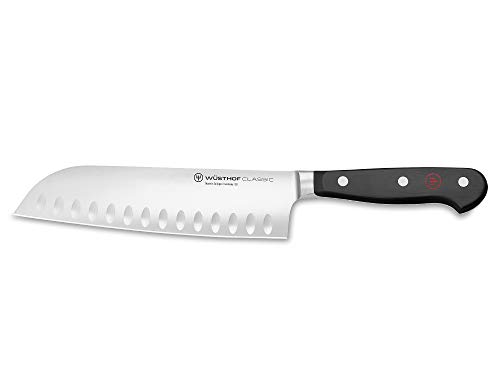
The German knife
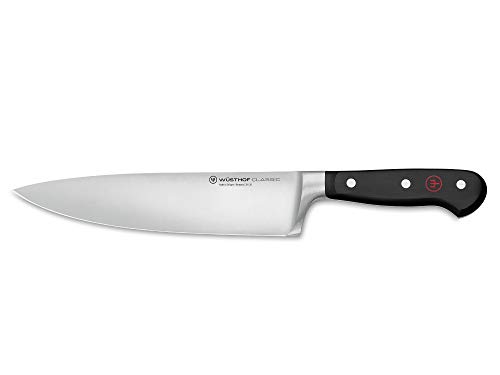
The German knife forgives. The Japanese knife rewards care. Which one to buy depends less on the knife than on the kitchen it is going into.
Tap either one to check today’s price.
The German knife
The Japanese knife

Even on the lines that differ: 1 each.
| Feature | Wusthof | Shun |
|---|---|---|
| Steel | Forged high-carbon German stainless | VG-MAX core, 34 layers of Damascus cladding each side |
| Hardness | 58 HRC | 60 to 61 HRC (maker's figure for VG-MAX) |
| Edge angle | 14 degrees per side | 16 degrees per side |
| Weight | 8.5 oz (listing figure) | 6.7 oz |
| Handle | Synthetic, triple riveted, full tang | D-shaped Pakkawood, composite tang |
| Bones and frozen food | Takes a chicken joint in stride (the edge) | Maker advises against bones, frozen food and very hard produce |
| Sharpening by the maker | No; Wusthof refers owners to a third-party service | Free for original owners, $15 US return fee (the edge) |
| Made in | Solingen, Germany | Japan (handcrafted) |
| WarrantyEven | Limited lifetime | Limited lifetime |
| Price | About $170 | About $140 to $190 |
The verdict
Buy the Wusthof Classic for a busy household kitchen where the knife will meet bones, hurried washing and more than one cook. Buy the Shun Classic if you cook carefully on a wooden board and want a lighter, harder blade that the maker will sharpen for you.
The chef's knife worth buying once.The chef's knife for under $100.The knife set for home cooks.
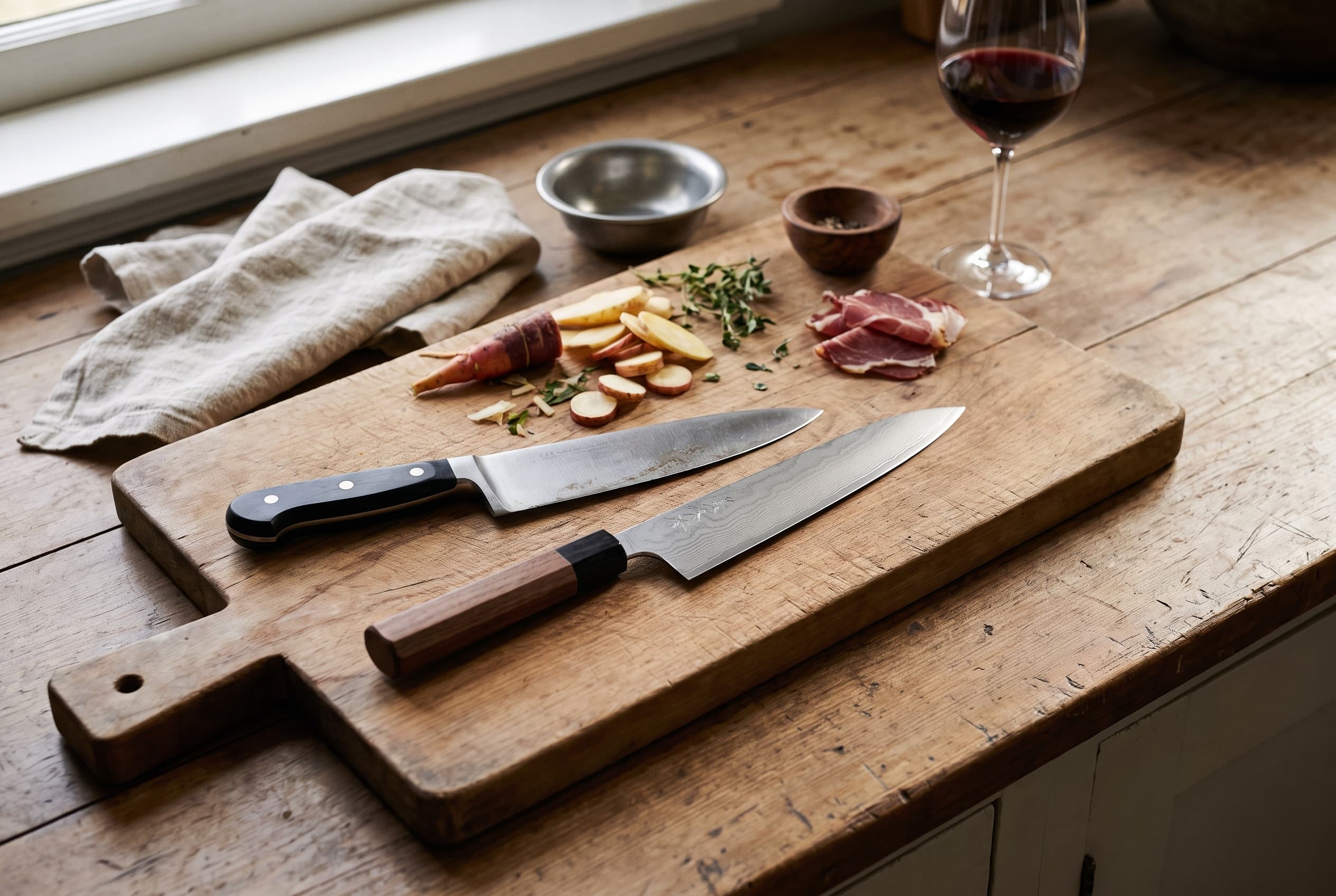
These are the two chef's knives most often weighed against each other: the Wusthof Classic 8 inch, forged in Solingen since long before anyone argued about it, and the Shun Classic 8 inch, made by Kai in Japan and for many American cooks the first Japanese knife they owned.
They differ in almost every way that matters. The Wusthof is heavier, tougher and softer, and it will take a knock against a chicken bone. The Shun is lighter, harder and holds its edge longer, and its maker asks you to keep it away from bones, frozen food and hard squash. Oddly, on paper the Wusthof leaves the factory with the finer edge angle.
The deciding question is usually who else will use it. A knife shared by a household, dropped in the sink and used to pry open a jar wants to be German. A knife used by one careful cook, on a wooden board, can be Japanese.
The tougher, heavier knife: fine for bones, forgiving of a hurried cook, easy to bring back with a steel.
The Classic is forged from a single block of high-carbon stainless steel and tempered to 58 HRC. Wusthof sharpens it by machine to 14 degrees per side, a finer angle than older German knives carried and, on paper, finer than the Shun's. The listing puts the weight at 8.5 ounces, with a triple-riveted synthetic handle over a full tang.
Softer steel is the reason to choose it. At 58 HRC the edge rolls rather than chips, so a knock against a bone or a plate is usually put right with a few strokes on a honing steel. The weight does some of the work on hard vegetables. It is the knife to buy when more than one person will use it.
The trade is that it dulls sooner than the Shun and needs honing more often. Wusthof does not run a mail-in sharpening service of its own. Skip it if you find heavy knives tiring or want a blade that stays keen for months.
The catch. Needs honing more often than the Shun, and the full bolster has to be ground back over years of sharpening.
Where to buy
AmazonCheck price →A lighter, harder blade that stays sharp longer, with the best maker-run sharpening program in the category.
Kai makes the Shun Classic in Japan. The blade has a VG-MAX steel core clad in 34 layers of stainless Damascus on each side, with a 16 degree edge per side. Shun hardens VG-MAX to 60 to 61 HRC. The D-shaped Pakkawood handle suits either hand, and the whole knife weighs 6.7 ounces, about two ounces less than the Wusthof.
Harder steel holds an edge longer, and a thinner blade passes through food with less force. The catch is spelled out in Shun's own FAQ: fine Japanese knives are built for keenness rather than toughness, and should not be used on bones, frozen food or very hard produce. Chopping hard against glass, stone or ceramic boards chips them.
Shun's sharpening service is what makes it practical. Original owners who bought from authorized dealers can send the knife to Kai in Tualatin, Oregon to be sharpened free, paying a $15 return and processing fee in the US, with about two weeks' turnaround. Skip it if the knife will be shared with people who use it as a pry bar.
The catch. Hard steel chips with bones, frozen food, hard boards or rough chopping. Never the dishwasher.
Where to buy
AmazonCheck price →A Japanese blade ground to a steeper, sharper edge than the Shun, for a cook who already sharpens.

Miyabi is Zwilling's Japanese line, made in Seki. The Kaizen has a VG10 steel core ice-hardened to 60 HRC, clad in 65 layers of Damascus, and is hand-honed to an edge of 9.5 to 12 degrees per side, much finer than either knife above. The handle is black Micarta with a steel end cap.
That edge is the reason to buy it and the reason to be careful with it. It will cut more cleanly than the Shun out of the box and chips as easily. There is no free maker sharpening in the style of Shun's, so it suits someone who owns whetstones.
Skip it if you want a knife that someone else will keep sharp.
The catch. The very fine edge chips easily, and you will need to sharpen it yourself or find someone who can.
Where to buy
AmazonCheck price →Shun's lower-priced chef's knife, with the same 16 degree edge and a polymer handle.
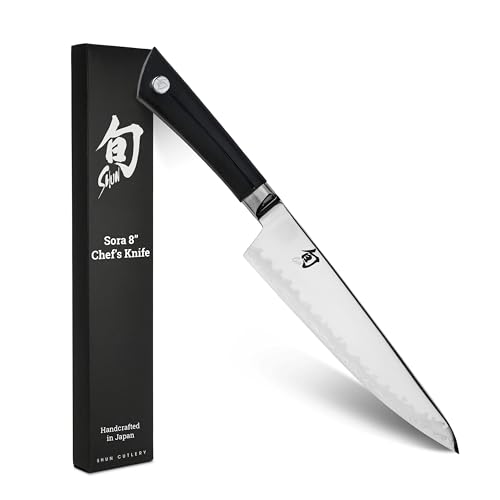
The Sora uses a composite blade: a VG10 cutting edge joined to a 420J stainless upper, with the same 16 degree edge per side as the Classic. The handle is a textured polymer blend over a full tang, and the blade is the narrower gyuto shape.
It gives you a hard Japanese edge and Shun's sharpening service for about $30 to $80 less than the Classic, depending on the day. It looks plainer and lacks the Damascus cladding.
Skip it if the Damascus and Pakkawood were the point.
The catch. Plain looks, and the same care rules as any hard Japanese blade.
Where to buy
AmazonCheck price →German knives like a grooved honing steel every few uses. Hard Japanese steel does better with a smooth or fine ceramic rod, used lightly. Shun sells its own steel with a 16 degree guide and suggests honing about once a week.
Use wood or soft plastic for both. Glass, marble and ceramic boards dull the German knife and chip the Japanese one. Neither maker wants its knife in the dishwasher; Shun warns that washing with other metals can leave brown spots on its blades.
Many cooks end up with both: a German knife for breaking down chickens and hard squash, and a Japanese one for herbs, fish and fine slicing. If you are buying one, buy for the kitchen you actually cook in.
Sharper for longer and lighter, yes. Tougher and easier to live with, no. Shun's steel is 60 to 61 HRC against Wusthof's 58, which holds an edge longer and chips more easily.
Both arrive very sharp. On paper the Wusthof Classic's 14 degree edge is finer than the Shun Classic's 16 degrees, but the Shun's harder steel keeps its edge longer.
Shun says no. Its FAQ advises against bones, frozen food and very hard produce. Use a German knife or a cleaver for that work.
For original owners who bought from authorized dealers, yes. In the US you pay shipping to Kai and a $15 return and processing fee. Kai estimates about two weeks.
Usually the Wusthof, or a cheaper stamped knife first. It tolerates mistakes that would chip a Japanese blade.
 KitchenHexClad vs Henckels Paradigm: Which Hybrid Pan to Buy
 KitchenLe Creuset vs Caraway Dutch Oven: Which to Buy
 KitchenBest Revolving Cake Stand for Decorating
 KitchenBest Cast Iron Skillet for a Glass Top Stove
 KitchenBest Chef's Knife Under $100: Five Worth Buying
 KitchenBest Cutting Board for Raw Meat and Poultry
 KitchenBest Cutting Board: End Grain vs Edge Grain Wood
 KitchenThe Best Meat Thermometers: Instant-Read and Leave-In
The Bonwits Letter
What is worth buying for the house this week, what is actually on sale, and what to skip. Short, and never sponsored.